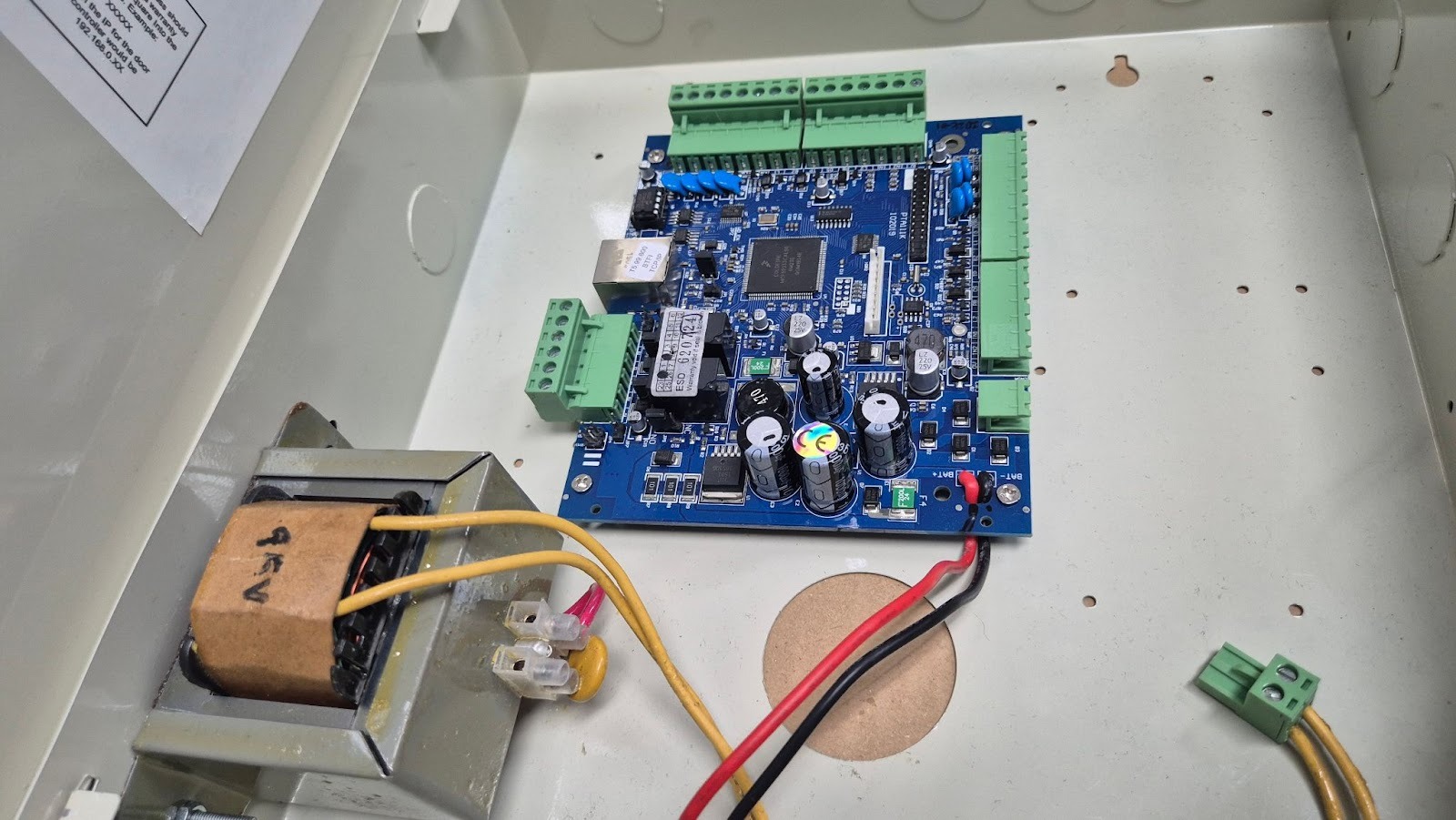
A door access controller is the central processing unit of any access control system. It is the hardware “brain” that manages, monitors, and enforces who is allowed to enter or exit a secured area. When a person presents a credential such as an RFID card, key fob, or fingerprint, the controller reads the signal, verifies it against its stored database, and either grants or denies access by triggering a connected lock or barrier. Without a controller, individual security devices such as biometric readers or magnetic locks cannot function as a unified, intelligent system.
Types of Door Access Controllers
Modern access control systems offer different controller types depending on the scale and complexity of your security needs.
Native POE Controller

A Native POE (Power over Ethernet) Controller is designed for straightforward, single-door or small-scale applications. It draws both data and power through a single Ethernet cable, simplifying installation and reducing wiring costs. The Native POE Controller is ideal for managing:
- Door access – controlling entry and exit through standard doorways.
- Physical push button switches – allowing authorized users to manually trigger door release.
- Magnetic locks (maglocks) – holding doors securely locked until access is granted.
This makes it a practical and cost-efficient choice for offices, server rooms, and interior secured areas where a clean, minimal installation is preferred.
Native IP Controller
A Native IP Controller is a more powerful, enterprise-grade solution built for large facilities and multi-point security environments. Operating over a standard IP network, it can manage multiple access points simultaneously and integrates with a wide range of security hardware. The Native IP Controller is suited for:
- Doors – standard secured entry points.
- Car park barriers and barrier sensors – controlling vehicular access.
- Turnstiles – managing pedestrian flow in high-traffic areas.
- Elevators – restricting floor access to authorized personnel only.
- Alarms – triggering alerts upon unauthorized access attempts.
- Rack cabinets – for bank vaults, gym lockers, or securing IT and server infrastructure.
- Card entry systems – managing credential-based access across an entire building.
What Can a Door Access Controller Connect To?
One of the greatest strengths of a modern door access controller is its ability to integrate with a wide ecosystem of security devices, including:
- Backup power supply — ensuring continued operation during power outages
- Biometric readers — fingerprint or facial recognition for high-security areas
- Barrier gates — managing vehicle entry in car parks or compounds
- Electromagnetic door locks — providing strong, reliable door holding force
- Physical button door switches — for manual, authorized exit triggers
- Electronic door locks — keypad or smart lock integration
- RFID door locks — contactless credential-based locking systems
- Card entry readers — swipe or tap card authentication at entry points

Why Door Access Controllers Matter: The Evidence
Research consistently supports the value of access control in reducing security incidents. A study published in the Journal of Applied Security Research found that facilities equipped with electronic access control systems experienced significantly fewer unauthorized entry incidents compared to those relying solely on traditional lock-and-key methods. Similarly, a report by the ASIS International Foundation highlighted that organizations implementing structured access control reduced internal theft and unauthorized access events by up to 40%. Furthermore, the Securitas Security Services Global Report noted that buildings with layered electronic access systems reported lower rates of workplace violence and trespassing, reinforcing that controlled entry points create measurable deterrence against criminal activity.
Conclusion
A door access controller is far more than a simple lock switch — it is the intelligent hub that brings your entire security ecosystem together. Whether you choose a Native POE Controller for a compact office setup or a Native IP Controller for a large commercial facility, investing in the right access control solution means safer spaces, smarter management, and peace of mind for everyone inside.
Sources:
1. University of North Carolina at Charlotte — Offender Perspectives Study (2012)
Researchers Dr. Joseph Cotropia and Dr. Marc Gertz surveyed 422 convicted burglars to understand what deters them from targeting a property. The study found that 60% of burglars said they would abandon a target if they discovered a security system was present. Visible access control measures — including locked entry systems, keycard readers, and electronic locks — were among the top deterrents cited by offenders.
Source: Burglar’s Perspective on Security — University of North Carolina, Charlotte, Department of Criminal Justice & Criminology (2012)
2. Rutgers University — Security and Crime Prevention Study
A study conducted by Rutgers University’s School of Criminal Justice found that the installation of electronic access control and security systems in residential and commercial properties led to a measurable reduction in burglary rates — not just in the secured building, but in the surrounding neighborhood as well, suggesting a diffusion-of-benefits effect where visible security discourages criminal activity in the broader area.
Source: Rutgers University, School of Criminal Justice — The Influence of Security Systems on Residential Burglaries
3. British Home Office Research — Secured by Design Program
The UK’s Home Office Research Study evaluated properties built under the Secured by Design (SBD) initiative — a program that mandates physical access security standards including controlled entry points and electronic locking systems. Results showed that SBD-certified homes and commercial buildings experienced up to 75% fewer burglaries compared to non-certified properties in the same area.
Source: Home Office Research Study 295 — Secured by Design, United Kingdom
4. ASIS International — Business Security & Loss Prevention Report
The ASIS International Foundation, one of the world’s leading security industry organizations, reported in its loss prevention research that businesses with structured electronic access control systems reduced incidents of internal theft, unauthorized entry, and workplace security breaches by up to 40% compared to businesses using only traditional lock-and-key systems.
Source: ASIS International Foundation — Business Security and Loss Prevention Research Report
5. FBI Uniform Crime Reporting (UCR) Program
The FBI’s Uniform Crime Reports consistently show that properties without any visible or electronic access security measures are 2.7 times more likely to be targeted for burglary than those with controlled entry systems. The data underscores that even the presence of an access control system serves as a powerful visual deterrent to would-be criminals.
Source: FBI Uniform Crime Reporting Program — Crime in the United States